
Updated 9 November 2026
What Will Happen to Planning Permission in Surrey When East and West Surrey Councils Take Over?
East and West Surrey Councils take over planning on 1 April 2027. See what happens to applications, permissions, Local Plans and committees.
Surrey's planning system changes on 1 April 2027. The county's two-tier local government structure will be replaced by two new unitary councils: East Surrey Council and West Surrey Council.
Planning responsibilities that are currently divided between Surrey County Council and the 11 borough and district councils will pass to the two new authorities. For homeowners, developers, landowners and construction businesses, that raises practical questions about who will decide applications, what happens to existing permissions and whether local planning policies will change.
The transition is more complicated than combining 12 councils into two. Existing Local Plans are expected to stay in use, applications should not need to be restarted because the responsible council changes, and the longer-term planning framework for Surrey is still being developed.
This article explains what is changing, what stays the same and what the reorganisation could mean for development across Surrey.
Information is accurate as of November 2026. Some transitional arrangements, particularly for Local Plans and strategic planning, remain subject to further government decisions.

Photo: Colin Smith, CC BY-SA 2.0, via Geograph and Wikimedia Commons.
When will East Surrey and West Surrey Councils take over?
From 1 April 2027, Surrey County Council and the 11 borough and district councils will be replaced by two unitary authorities. This is provided for by the Surrey (Structural Changes) Order 2026, which the government confirmed was signed on 9 March 2026. Elections to the new councils took place on 7 May 2026, and the new councils are operating as shadow authorities until they take over.
The split is:
| East Surrey Council | West Surrey Council |
|---|---|
| Elmbridge | Guildford |
| Epsom & Ewell | Runnymede |
| Mole Valley | Spelthorne |
| Reigate & Banstead | Surrey Heath |
| Tandridge | Waverley |
| Woking |
Each new authority replaces Surrey County Council and the borough and district councils in its area, taking on both county-level and district-level functions, including planning, housing, highways, waste and social care.
This is not a single Surrey-wide council. East and West Surrey are separate unitary authorities, each responsible for its own area.
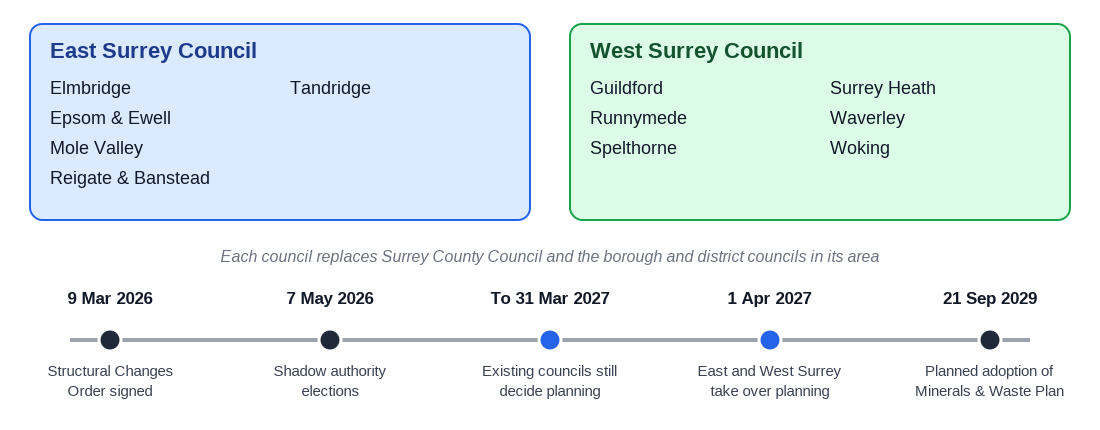
The government launched a national review of local government reorganisation in September 2026, but confirmed that reorganisation in Surrey would not be affected. The councils say the programme remains on track for April 2027.
What happens to planning applications after April 2027?
The most immediate change is that planning responsibilities will sit in one place for each area.
Under the current two-tier system, the borough or district council is usually the local planning authority for everyday applications, while Surrey County Council has separate planning responsibilities, particularly for minerals and waste development. For example:
- A homeowner applying for an extension in Woking currently deals with Woking Borough Council.
- A developer proposing housing in Guildford currently deals with Guildford Borough Council.
- A minerals or waste application is generally dealt with by Surrey County Council.
From 1 April 2027, those responsibilities pass to the relevant unitary authority. East Surrey Council will be the planning authority for Elmbridge, Epsom & Ewell, Mole Valley, Reigate & Banstead and Tandridge. West Surrey Council will be the planning authority for Guildford, Runnymede, Spelthorne, Surrey Heath, Waverley and Woking.
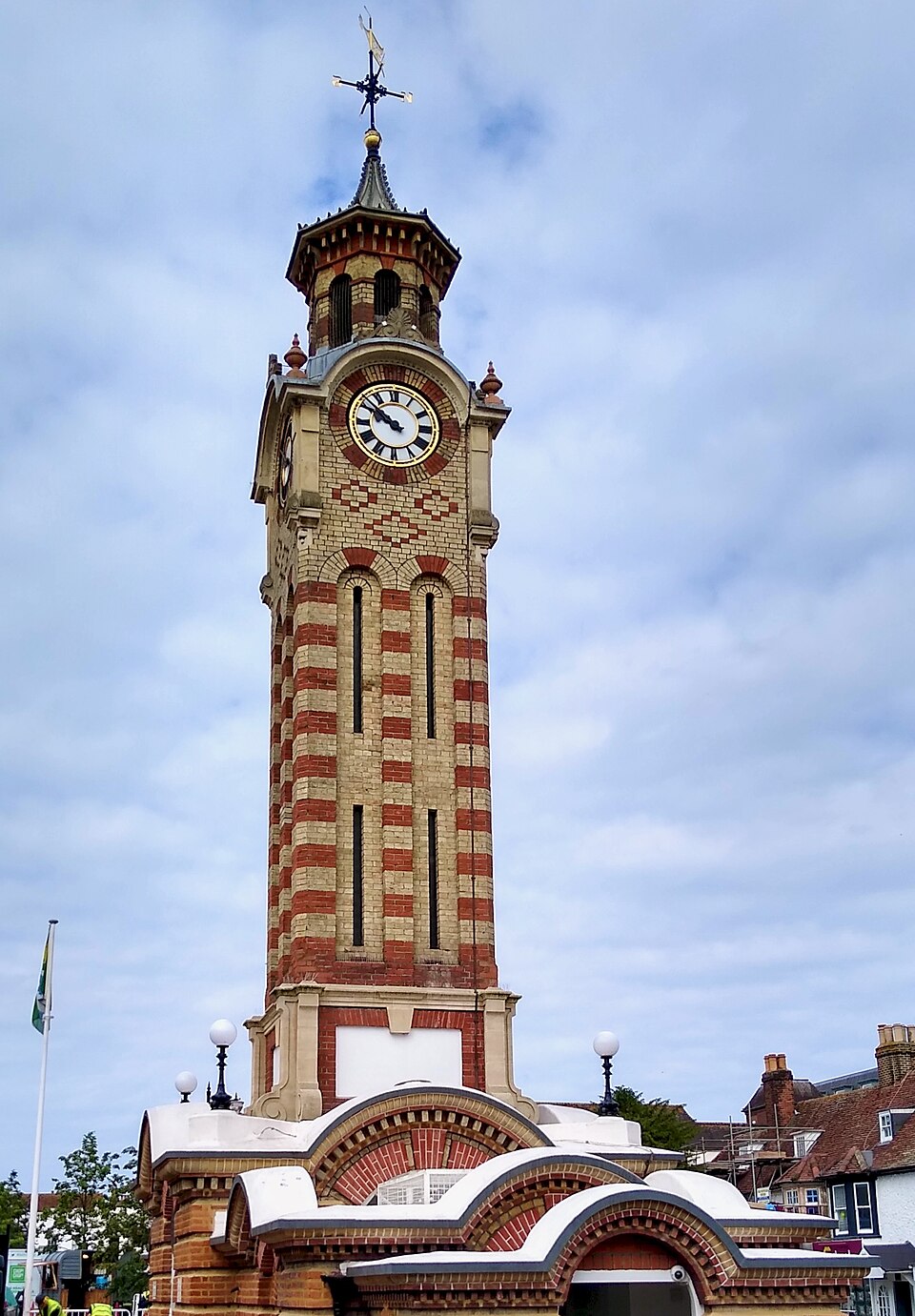
Photo: Mertbiol, CC0, via Wikimedia Commons.
Will the new councils have one planning department?
The intention is to bring the existing responsibilities into a single unitary structure, but that does not necessarily mean one office or one team handling every application. The new authorities will decide how planning services are organised, including:
- Whether existing planning teams are combined into larger departments.
- How development management teams are allocated across the new areas.
- Whether specialist teams are centralised or keep local arrangements.
- How enforcement, appeals and compliance work are managed.
- How planning committees and delegated decision-making are structured.
The shadow authorities are preparing governance arrangements, constitutions and organisational structures, so the detail should become clearer during the transition. Do not assume that a particular office, planning portal or planning officer contact will stay unchanged after April 2027.
What happens to existing planning permissions and pending applications?
For anyone with a live project, the key question is whether a permission or application is affected. The reorganisation is not intended to cancel existing permissions or make applicants start again.
Existing planning permissions
Planning permission generally runs with the land rather than belonging only to the person or company that applied. A permission does not ordinarily become invalid because the responsible council changes, and its approved development, conditions and obligations continue to apply. The Planning Portal explains that permission usually stays with the land or building when it is sold or let, subject to any conditions that limit who benefits.
For example, a developer granted permission by Guildford Borough Council before April 2027 will not ordinarily need to reapply simply because West Surrey Council takes over the planning function. The same applies in East Surrey.
Applications that have not been decided
The expectation is that pending applications will continue through the process rather than being cancelled. Until 31 March 2027, the existing councils remain responsible for their planning services and for individual applications, and the shadow authorities do not manage individual casework. From 1 April 2027, the relevant new council takes over the statutory planning responsibilities for its area.
The Structural Changes Order requires the existing councils to cooperate with the shadow authorities so that functions, property, rights and liabilities transfer effectively. There is no indication that applicants will need to withdraw and resubmit a valid application because their council is being replaced.
The practical details, such as how case files, planning registers, online accounts and application references are transferred, may differ between authorities. If you have a live case, follow communications from your current council and check for updated contact details closer to April 2027.
Conditions, enforcement and appeals
The new councils will also inherit the planning responsibilities attached to their areas. That includes applications to discharge or vary conditions, Lawful Development Certificates, enforcement investigations, appeals and their records, planning obligations and monitoring, and compliance with approved plans.
A permission can involve years of conditions, legal agreements, reserved matters and compliance requirements, so an accurate transfer of planning records matters particularly for developers.
Will the existing Local Plans still apply?
Existing adopted Local Plans are expected to remain in use after April 2027.
A Local Plan sets out where development should go, which areas are protected and what proposals must satisfy. Applications are decided with reference to the development plan alongside national policy and other material considerations. Surrey currently has separate Local Plans for its borough and district areas, and replacing them all on 1 April 2027 would create considerable uncertainty.
The government's draft guidance on plan-making during local government reorganisation says it wishes to ensure adopted plans can remain in force for the part of the new unitary area to which they relate until a new unitary-wide plan supersedes them. In practice, East Surrey Council is expected to inherit the plans for Elmbridge, Epsom & Ewell, Mole Valley, Reigate & Banstead and Tandridge, and West Surrey Council those for Guildford, Runnymede, Spelthorne, Surrey Heath, Waverley and Woking. Each new council would therefore start out applying several different Local Plans across its area.
There is an important qualification. The guidance is explicitly draft guidance and "a statement of intention rather than a statement of finalised policy". The government has said it intends to publish transitional regulations, including on how emerging plans progress after unitarisation and on more than one plan having effect in an area during the transition.
Will East and West Surrey eventually have their own Local Plans?
That is the expected direction of travel. A unitary authority needs a planning framework for its whole area, and wider plans could give a more consistent approach to housing, employment land, infrastructure and environmental protection.
Preparing a Local Plan takes years of evidence gathering, consultation, technical assessment, examination and adoption, so comprehensive council-wide plans are unlikely to be ready in April 2027. The existing district plans are likely to stay important during the transition.
What is happening to the Local Plans already being prepared?
Each council is at a different stage, and the examples show how policy may develop after the new authorities take over.
Epsom & Ewell: Local Plan 2022-2040
Epsom & Ewell's Local Plan is at the examination stage. A six-week consultation on the Inspector's proposed Main Modifications opened on 2 November 2026 and closes on 14 December 2026. The council expects the Inspector's report in February 2027 and a Full Council adoption decision in March 2027. These are expectations rather than confirmed dates.
If the plan is adopted before 1 April 2027, it will already be part of the framework when East Surrey Council takes over. The council has also said adopted borough Local Plans will continue to apply until East Surrey adopts a Local Plan for its wider area, which it expects to take several years.
Elmbridge: Local Plan 2039
Elmbridge is starting a new Local Plan, with a scoping consultation running from 4 November to 9 December 2026. The council will remain the planning authority until April 2027, and it is accepting site submissions through its Call for Sites. East Surrey Council will decide how the work is taken forward after the handover, whether by continuing the Elmbridge plan or folding the evidence into a wider East Surrey strategy.
Submitting a site does not mean it will be allocated or granted planning permission.
Reigate & Banstead: Local Plan 2044
Reigate & Banstead's published timetable runs across the reorganisation:
| Milestone | Timetable |
|---|---|
| Notice to commence | 31 July 2026 |
| Scoping consultation | September to October 2026 |
| Gateway 1 | December 2026 |
| East Surrey Council established | April 2027 |
| Consultation on draft vision and spatial strategy | June to July 2027 |
| Consultation on proposed policies and site allocations | March to May 2028 |
| Submission for examination | December 2028 |
| Examination | January to May 2029 |
| Adoption | June 2029 |
The timetable is the borough's, but East Surrey Council will be the planning authority for many of the later stages.
Guildford: a new Local Plan for the borough area
Guildford is preparing a single new Local Plan under the government's new plan-making system, with a scoping consultation that ran from 2 September to 14 October 2026. The council says the plan will still be in progress when West Surrey Council takes over, and that government expects plan preparation to continue without delay. The plan area is currently expected to match the borough boundary, although a future plan will likely cover a larger area.
Tandridge: Local Plan 2027-2042
Tandridge says its Local Plan will continue after reorganisation, and that existing Local Plans and evidence transfer to East Surrey Council. If the plan is adopted, East Surrey Council will use it to make decisions in the former Tandridge area.
What does this mean for developers?
A developer submitting an application in 2027 or 2028 may be dealing with East Surrey Council or West Surrey Council, but the Local Plan that applies may still be the one prepared for the former borough or district. The council name will change before the planning policy framework is consolidated.
The relevant Local Plan, site allocations, housing land supply position and supporting evidence therefore remain important when assessing a site.
What happens to minerals and waste planning?
Surrey County Council is currently responsible for minerals and waste planning across the county, covering policies and decisions on mineral extraction, aggregates, waste management and associated facilities.
From 1 April 2027, East Surrey Council and West Surrey Council each become the minerals and waste planning authority for their areas. The county council's Minerals and Waste Local Plan timetable continues through the reorganisation:
- A scoping consultation from 17 December 2026 to 29 January 2027.
- Formal commencement of the 30-month preparation period on 19 March 2027.
- Preparation continuing under East and West Surrey from April 2027.
- Submission for examination on 1 November 2028.
- Examination between April and July 2029.
- Adoption by both councils on 21 September 2029.
Until a new plan is adopted, the existing minerals and waste planning framework remains relevant to decisions.
Will planning committees and decision-making change?
They are likely to, but the arrangements are not yet fully established. Each borough or district currently has its own system for deciding applications, with some decided by officers under delegated powers and others by committee.
The new councils will set their own constitutions and schemes of delegation, which determine which applications officers decide, which go to committee, how committees are structured, how councillors take part, how public speaking works and how decisions are scrutinised. A council could use a single planning committee for the whole area, or keep geographically organised committees to preserve local representation.
The shadow authorities are preparing these arrangements but do not make individual planning decisions. The committee arrangements your borough or district uses today should not be assumed to continue unchanged after April 2027.
Could the reorganisation make planning decisions faster?
One reason the government gives for reorganisation is to simplify responsibilities and reduce fragmentation. A housing development today can involve the borough or district council as planning authority, the county council as highways authority, the county council on education provision and county-level minerals and waste functions where relevant.
Under the new structure each council will combine a broader range of services, which in principle could make it easier to coordinate planning with transport, education, infrastructure and housing.
There is no guarantee that applications will be decided more quickly just because the councils are reorganised. The new authorities must integrate staff, systems, records and budgets, and combining planning teams and policy frameworks can create short-term operational challenges. Whether performance improves depends on resourcing, the quality of the transition and how well each council organises its services. More joined-up local government should not be confused with a confirmed reduction in decision times.
Will there be one planning strategy for the whole of Surrey?
Another development could influence planning across the county: Spatial Development Strategies (SDSs). An SDS is a high-level strategy that coordinates development and infrastructure across a wider area. It is different from a Local Plan, which holds the more detailed policies and site allocations for an area. An SDS addresses issues such as strategic housing requirements, major infrastructure and transport, economic growth, environmental protection and cross-boundary development.
The Planning and Infrastructure Act 2025 provides for a new strategic planning system in England, including duties to prepare SDSs. The government has consulted on the areas for which SDSs should be produced, and the outcome for Surrey should be checked against the government's decision.
Could a Surrey-wide strategic authority be created?
There is a proposal for a Foundation Strategic Authority for Surrey. The government said it intended to support one by April 2027, and a local consultation was planned for summer 2026 ahead of a proposal to government in September 2026. The West Surrey shadow authority's executive was due to consider its response to the government consultation on 15 September 2026.
As of November 2026, that should not be read as confirmation that a strategic authority has been established, and the final decision and the division of strategic responsibilities remain open questions. If one is created, it could shape Surrey-wide planning and infrastructure strategy, but it would not simply replace East Surrey Council and West Surrey Council as the bodies deciding ordinary planning applications. The likely result is two levels: the two councils handling local applications and Local Plans in their areas, and a Surrey-wide structure coordinating strategic growth, depending on the final arrangements.
What is happening during the transition period?
The shadow authorities were elected on 7 May 2026 to prepare the new councils before they take over. Their work includes agreeing organisational structures, appointing senior officers, setting up governance and decision-making arrangements, preparing budgets and constitutions, coordinating the transfer of services and records, and planning how the councils will operate from April 2027.
The shadow authorities are not responsible for deciding planning applications. Until 31 March 2027, continue dealing with your existing borough, district or county council, depending on the type of planning matter.
What should homeowners, developers and landowners do now?
For most people, nothing needs to change immediately. Planning services continue under the existing structure until 1 April 2027, and applications should still go to the current local planning authority. Anyone involved in a development project should know which new authority will take over their area and keep track of the transition.
If you have a planning application in progress
Keep dealing with your existing planning authority until the handover, and keep copies of:
- The application reference and submitted documents.
- Drawings and supporting reports.
- Correspondence with planning officers.
- Consultation responses.
- Planning conditions and decision notices.
- Any section 106 agreements or other planning obligations.
Check for communications about planning portals, contact details and case references closer to April 2027. There is no reason to withdraw a valid application solely because the authority is changing.
If you own land with development potential
Review the Local Plan and any emerging policies covering your site, including housing allocations, Green Belt and settlement boundaries, infrastructure requirements and supplementary guidance. Wider strategies may eventually follow, but the existing district-based policies are expected to matter during the transition.
If you are preparing a major development
Consider the wider context, particularly where a site crosses borough boundaries or depends on infrastructure delivered by more than one authority. Emerging Surrey-wide strategic planning arrangements may become more relevant for larger residential and mixed-use schemes. It is also worth following the new councils' governance arrangements to see how committees and officer decisions will be organised.
If you are planning work to your own home, see our guides on whether you need planning permission for an extension and planning permission for house extensions in Surrey.
How Fort can support your building project
Planning permission is only one part of delivering a successful project. Once the approvals are in place, homeowners and developers still need to agree the work, appoint suitable tradespeople and manage the project through to completion.
Fort provides a shared platform for organising residential construction projects. Homeowners can find and connect with vetted tradespeople, agree the proposed work, organise project stages and keep important information in one place. Tradespeople can bring existing projects onto Fort, helping them manage agreed work and spend less time chasing payments.
With milestone-based payments and a shared project record, both parties keep a clearer understanding of what has been agreed and what happens next.
Create your Fort account, or see how Fort works for homeowners.
Sources and methodology
This article draws on the Surrey (Structural Changes) Order 2026, government and Surrey LGR Hub pages, the government's draft plan-making guidance and the published Local Plan pages of the councils named above, all listed below. Plan timetables are the councils' own and can change. It provides general information, not planning or legal advice, so check the current position with your local planning authority.
Last reviewed: November 2026.
Frequently asked questions
- On 1 April 2027. Until 31 March 2027, the existing borough, district and county councils remain responsible for their current planning functions, and the shadow authorities do not handle individual planning casework.
- Woking will be part of West Surrey Council. From 1 April 2027, West Surrey Council takes over the planning responsibilities currently handled by Woking Borough Council.
- Guildford will be part of West Surrey Council. From 1 April 2027, it will be responsible for planning applications and local planning functions in the former Guildford Borough Council area.
- Elmbridge will be part of East Surrey Council, which takes over its local planning responsibilities from 1 April 2027.
- No. The reorganisation is not intended to cancel existing planning permissions or require applications to be resubmitted solely because the council changes. Planning permission generally runs with the land, and the new authority takes over the relevant planning responsibilities.
- No. The government's stated intention, in draft guidance, is that adopted Local Plans remain in force for the areas they currently cover until a new unitary-wide plan replaces them. Transitional regulations are still to be published.
- That is the expected long-term direction, but new council-wide plans take years to prepare. Existing district-based plans, and new plans already under way, are likely to matter in the meantime.
- Not necessarily. Reorganisation is meant to simplify local government and improve coordination, but there is no guarantee of faster decisions. Performance depends on how well the new councils combine their teams, systems and resources.
- It passes to East Surrey Council and West Surrey Council for their respective areas. They are expected to continue preparing the new Minerals and Waste Local Plan, currently scheduled for adoption on 21 September 2029.
- The new councils will set their own committee structures and schemes of delegation, and the arrangements have not yet been fully established. Do not assume your current borough or district committee arrangements will continue unchanged.
When will East Surrey and West Surrey Councils take over planning?
Which council will handle planning applications in Woking?
Which council will handle planning applications in Guildford?
Which council will handle planning applications in Elmbridge?
Will I need to reapply for planning permission after April 2027?
Will the existing Local Plans be cancelled?
Will East Surrey and West Surrey have their own Local Plans?
Will planning applications be decided faster?
What happens to Surrey County Council's minerals and waste planning role?
Will there be one planning committee for each new council?
Want Fort in your Google Top Stories?
Build with Fort
Milestone payments, vetted Contractors, and clearer project communication - for Homeowners and Contractors.